Skip to main contentThis page explains how Nuggets enables privacy-preserving trust in autonomous AI systems.
Nuggets is designed to minimise the collection, storage, and exposure of personal data while still enabling verifiable identity, consent, authority, and compliance. Rather than centralising personal information, Nuggets focuses on proving that actions were authorised - without requiring access to the underlying data.
Privacy in Nuggets is not achieved by storing or managing personal data.
It is achieved by avoiding the need to access or retain it in the first place.
By binding identity, authority, intent, policy, and consent to actions as cryptographic proofs, Nuggets enables systems to remain auditable and accountable while respecting data-minimisation and purpose-limitation principles by design.
What Privacy in Nuggets Is - and Is Not
Privacy in Nuggets Is
- Privacy by design, enforced at the point of action
- Data minimisation through cryptographic proof rather than inspection
- Selective disclosure based on necessity, not convenience
- Auditability without full data exposure
- Compatibility with strict regulatory and jurisdictional requirements
Privacy in Nuggets Is Not
- A data storage platform
- A personal data vault
- A consumer data management system
- A centralised repository of personal information
Nuggets does not require organisations to pool, retain, or expose raw personal data in order to establish trust.
Why Privacy Breaks in Autonomous Systems
As AI systems become autonomous, they increasingly act on sensitive information across tools, clouds, and organisations.
Traditional approaches to trust and compliance rely on:
- collecting more data
- storing more logs
- retaining more context “just in case”
As autonomy scales, this approach creates significant risk:
- expanded attack surfaces
- higher breach impact
- conflicts between auditability and privacy obligations
- regulatory exposure across jurisdictions
In autonomous systems, trust cannot depend on data accumulation.
It must be proven without excessive data exposure.
Privacy-Preserving Trust as a Solution
Nuggets enables organisations to prove that actions were authorised and compliant without requiring access to raw personal data.
Instead of centralising information, Nuggets focuses on:
- verifying authority rather than inspecting content
- producing cryptographic proof rather than retaining sensitive records
- enforcing consent and policy without persistent data collection
This allows autonomous systems to operate responsibly while preserving privacy by design.
How Privacy-Preserving Trust Works
Authority Without Data Exposure
Human and organisational decisions - including consent, delegation, and constraints - are defined in advance and issued as verifiable credentials.
At runtime:
- agents present cryptographic proofs of authority
- Nuggets verifies validity and applicability
- actions are permitted or denied
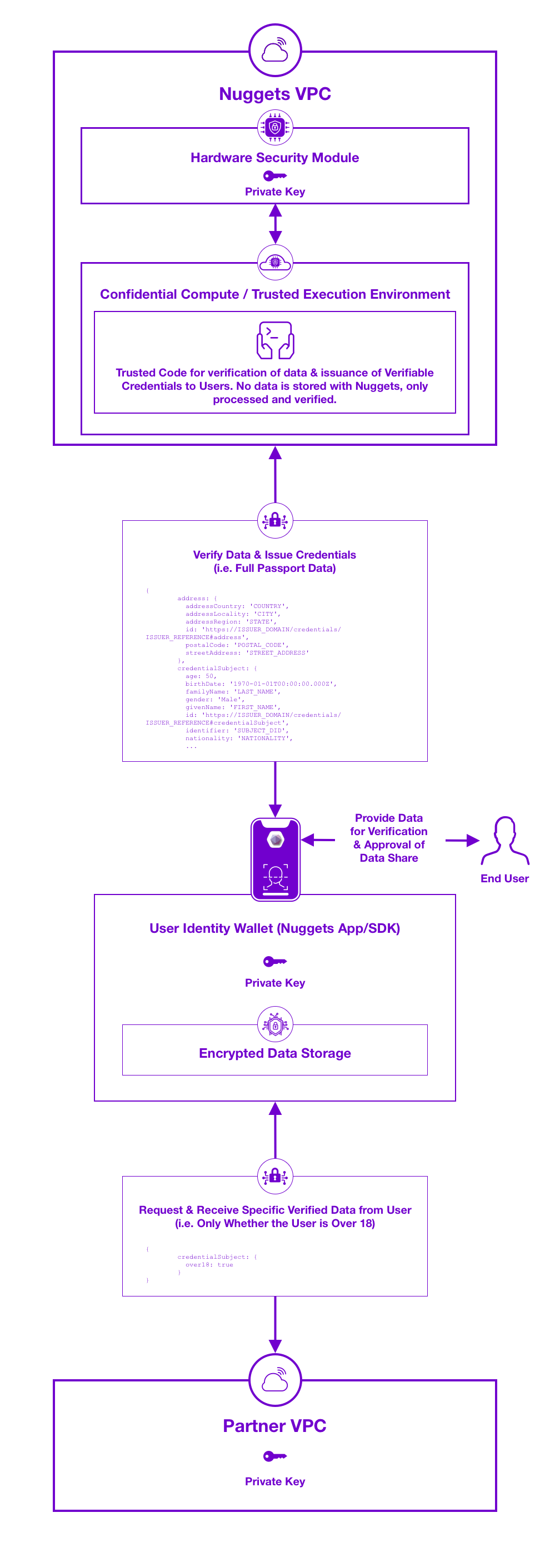
The underlying personal data does not need to be accessed, stored, or exposed to the trust layer.
Proof Without Disclosure
For each evaluated action, Nuggets generates cryptographic evidence proving:
- valid authority existed
- applicable policies were enforced
- consent requirements were met
This evidence demonstrates control and compliance without revealing what data was processed.
Consent That Travels With Actions
In autonomous systems, consent must be:
- explicit
- contextual
- enforceable across system boundaries
Nuggets binds consent to authority as verifiable credentials.
When an action is attempted, consent is evaluated automatically alongside policy and intent - ensuring that personal data is only accessed within approved boundaries.
Consent is preserved as cryptographic proof, not as retained personal information.
What Problems This Solves
Privacy-preserving trust enables organisations to:
- minimise retention of personal data
- reduce breach and insider-risk exposure
- satisfy data-minimisation and purpose-limitation requirements
- support cross-border and cross-regulatory deployments
- reconcile auditability with privacy obligations
This is critical for deploying autonomous AI in environments subject to strict privacy regulation.
How This Fits With the Nuggets Trust Model
Privacy-preserving trust works alongside:
- Verifiable Actor Identity - establishes accountable actors
- Action Authorisation for Autonomous Systems - enforces limits at runtime
- Human Authority & Oversight - defines consent and boundaries
- Provable Compliance - enables audit without disclosure
Together, these allow organisations to scale autonomy without centralising personal data.
When to Use This Approach
This approach is appropriate when:
- autonomous systems handle personal or sensitive information
- privacy regulation applies across jurisdictions
- data minimisation is a hard requirement
- trust must be proven without exposing underlying data
If your AI systems must act on sensitive information while preserving privacy, privacy-preserving trust is essential.
For detailed technical specifications and implementation guides, explore our full documentation.
How Nuggets keeps your data private: